Sawan 2100 Start & End Date (Shravan Maas)
North India (Purnimanta): Thursday, 22 July 2100 – Thursday, 19 August 2100
Amanta regions: Friday, 6 August 2100 – Saturday, 4 September 2100
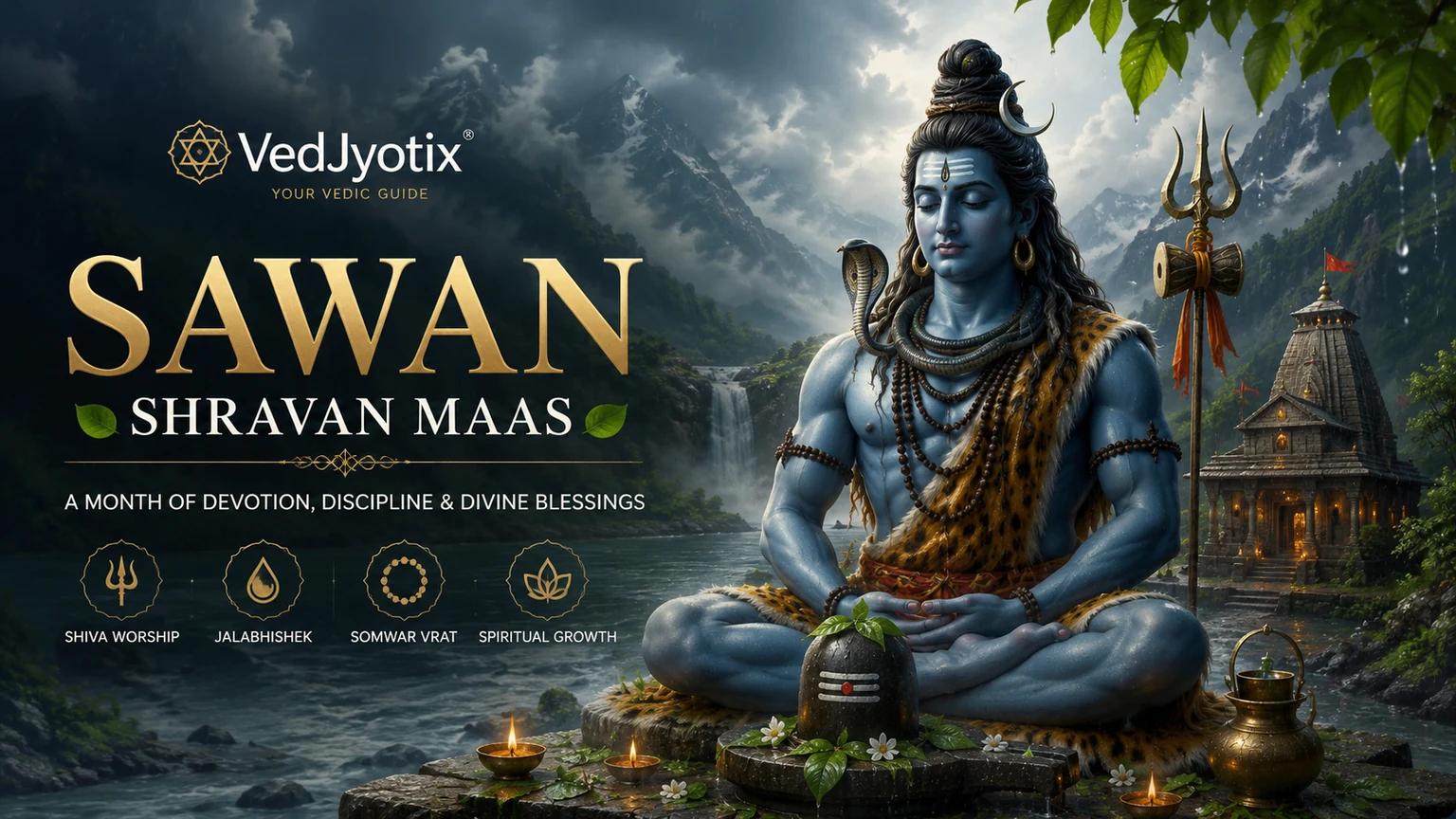
The holiest month for Shiva — the month of the Sawan Somwar vrat, kanwar yatra and Rudrabhishek.
Sawan 2100 at a Glance
- Sawan Somwar
- 4 · first Mon, 26 Jul
- Purnima
- Thu, 19 Aug
- Amavasya
- Thu, 5 Aug
- Sawan Somwar
- 4 · first Mon, 9 Aug
- Sawan Shivratri
- Fri, 3 Sept
- Purnima
- Thu, 19 Aug
- Amavasya
- Sat, 4 Sept
The significance of Sawan — Lord Shiva
Shravan is the month of Shiva. It falls at the height of the monsoon, when the earth is green and the samudra manthan is remembered — Shiva drank the halahala poison in this season to save creation, and the month's water-offerings cool that burning throat. Every Monday is kept as a Sawan Somwar fast, and pilgrims carry Ganga water on foot (the kanwar yatra) to pour over the lingam.
Rituals of Sawan
- Sawan Somwar vrat every Monday
- Rudrabhishek and jalabhishek of the Shiva lingam
- The kanwar yatra — carrying Ganga water on foot
- Offering bel-patra, dhatura and white flowers
- Reciting the Shiva Chalisa and Mahamrityunjaya mantra
- Mangala Gauri vrat on Tuesdays for married women
Key days in Sawan 2100
Vrat and tithi dates follow whichever month window your calendar uses, so both systems are listed separately below.
North India · Purnimanta
Thu, 22 Jul – Thu, 19 Aug · 29 days
Sawan Somwar Vrat · 4
Amanta regions
Fri, 6 Aug – Sat, 4 Sept · 30 days
Sawan Somwar Vrat · 4
Festivals in Sawan 2100
Within the Purnimanta window (Thu, 22 Jul – Thu, 19 Aug). Festivals are fixed by tithi, so each falls on the same civil day in both systems.
Also inside Amanta Sawan (Fri, 6 Aug – Sat, 4 Sept)
Monthly vrats 2100
Observances through Sawan
- Sawan Somwar Vrat
- The Mondays of the month, kept for Shiva. The best known observance of Sawan and the reason the month is counted in Mondays rather than days.
- Mangla Gauri Vrat
- The Tuesdays of the month, kept for Parvati as Mangla Gauri — traditionally by married women for the wellbeing of the family, and by unmarried women seeking a good match.
- Kanwar Yatra
- Pilgrims (kanwariyas) carry Ganga water on foot, most visibly from Haridwar, Gaumukh and Sultanganj, to offer at a Shiva temple on Sawan Shivratri. Largest across Uttar Pradesh, Uttarakhand, Bihar, Jharkhand, Haryana and Delhi.
- Sawan Shivratri
- The Masik Shivaratri of this month, on the Krishna Chaturdashi. Night worship and jalabhishek are traditional, and it is the day most Kanwar Yatra offerings are made.
How observance differs by region
- North India (Purnimanta)
- The month begins the day after Ashadha Purnima and ends on Shravana Purnima. Mondays are the principal vrat and the Kanwar Yatra is at its largest here.
- Maharashtra, Gujarat, Karnataka, Andhra Pradesh, Telangana, Tamil Nadu, Goa (Amanta)
- Shravana begins about fifteen days later, running new moon to new moon, so the Mondays counted as Shravan Somwar are a different set. Shravana Shanivar (Saturdays) and Mangala Gauri are widely kept alongside them.
- Tamil Nadu and Kerala
- The solar month Aadi overlaps Shravana. Aadi observances follow the solar calendar and do not track the lunar month boundaries used here.
- Nepal
- Shrawan follows the Bikram Sambat calendar; Mondays at Pashupatinath are the focus, and unmarried women commonly wear green bangles through the month.
Sawan 2100 — Frequently Asked Questions
When does Shravan Maas 2100 start?
In North India (Purnimanta calendar) Sawan runs from Thursday, 22 July 2100 to Thursday, 19 August 2100. In Amanta-calendar regions it runs Friday, 6 August 2100 to Saturday, 4 September 2100.
Why do Sawan dates differ in North and South India?
Because the two regions follow different lunar calendars. In the Purnimanta calendar (North India) a month ends on the Purnima, so it starts about 15 days earlier than in Amanta. In the Amanta calendar (Andhra Pradesh, Telangana, Goa, Maharashtra, Gujarat, Karnataka and Tamil Nadu) the month runs new-moon to new-moon.
Which deity is Sawan 2100 dedicated to?
Shravan is the month of Shiva. It falls at the height of the monsoon, when the earth is green and the samudra manthan is remembered — Shiva drank the halahala poison in this season to save creation, and the month's water-offerings cool that burning throat. Every Monday is kept as a Sawan Somwar fast, and pilgrims carry Ganga water on foot (the kanwar yatra) to pour over the lingam.
How many Sawan Somwars are there in 2100?
In North India (Purnimanta) Sawan 2100 has 4 Somwars — Monday, 26 July 2100, Monday, 2 August 2100, Monday, 9 August 2100, Monday, 16 August 2100. Amanta regions run the month on different dates, so there the count is 4: Monday, 9 August 2100, Monday, 16 August 2100, Monday, 23 August 2100, Monday, 30 August 2100.
When is the first Sawan Somwar in 2100?
The first Sawan Somwar in North India falls on Monday, 26 July 2100. In Amanta-calendar regions the first one falls on Monday, 9 August 2100.
When does Sawan 2100 end?
In North India (Purnimanta) Sawan ends on Thursday, 19 August 2100, on the Purnima. In Amanta regions it ends on Saturday, 4 September 2100, on the Amavasya.
Are Sawan and Shravan Maas the same month?
Yes. Shravan Maas is the Sanskrit name of this lunar month and Sawan is the everyday Hindi form of the same word. They refer to the same period — different names, not different dates.
What is observed during the Sawan Somwar vrat?
The vrat is resolved (sankalp) on the morning of the Monday itself, after bathing and before the first offering — many say it aloud in front of the lingam or a picture of Shiva. Commonly taken: fruit, milk, curd, sabudana, singhara or kuttu flour, potatoes, rock salt (sendha namak), nuts and water.
Is Sawan 2100 an Adhik Maas?
No. Sawan 2100 is a normal 29-day month.